Saturday, 31 October 2015

Bowdoin College

Bowdoin College


Bowdoin College  is a private liberal arts college located in the coastal Maine town of Brunswick. Founded in 1794, the college currently enrolls 1,839 students, and has been coeducational since 1971. Bowdoin offers 33 majors and four additional minors, and has a student–faculty ratio of 9:1. Notable alumni include Nathaniel Hawthorne, Henry Wadsworth Longfellow, Thomas Brackett Reed, Franklin Pierce, and Joshua Chamberlain.
Bowdoin is consistently ranked as one of the top 10 liberal arts colleges in the US, and was tied with Pomona as the fifth-best liberal arts college in the U.S. in the 2015 U.S. News & World Report rankings.
Bowdoin is located on the shores of Casco Bay and the Androscoggin River, 12 miles (19 km) north of Freeport, Maine, and 28 miles (45 km) north of Portland, Maine. In addition to its Brunswick campus, Bowdoin also owns a 118-acre (478,000 m²) coastal studies center on Orr's Island and a 200-acre (809,000 m²) scientific field station on Kent Island in the Bay of Fundy.
Contents  
1 History
1.1 Founding and 19th century
1.2 Twentieth century
1.3 Recent developments
2 Academics
2.1 Rankings
2.2 Admissions
3 Student life
4 Postgraduate placement
5 Student organizations
5.1 Media and publications
5.2 A cappella
5.3 Other
6 Environmental record
6.1 Commitment to action on climate change
6.2 Energy profile
6.3 Energy investments
7 Campus
8 Athletics
8.1 Facilities
9 Sustainability
10 Bowdoin alumni
11 Bowdoin in literature and film
12 Presidents of Bowdoin
13 References
14 Further reading
15 External links
History
Founding and 19th century
Bowdoin College, circa 1845. Lithograph by Fitz Hugh Lane
Bowdoin College was chartered in 1794 by Governor Samuel Adams of Massachusetts, of which Maine was then a district, and was named for former Massachusetts governor James Bowdoin, whose son James Bowdoin III was an early benefactor. At the time of its founding, it was the easternmost college in the United States. It is thought that the Bowdoin seal, created in 1798 by Joseph Callender, was a sun because it was the first college in the United States to see the sunrise.
Bowdoin came into its own in the 1820s, a decade in which Maine became an independent state as a result of the Missouri Compromise and the college graduated a number of its most famous alumni, including future United States President Franklin Pierce, class of 1824, and writers Nathaniel Hawthorne and Henry Wadsworth Longfellow, both of whom graduated Phi Beta Kappa in 1825.
Bowdoin College Chapel, 2014
From its founding, Bowdoin enjoyed a reputation for academic rigor, and "catered very largely to the elite from the state of Maine." During the first half of the 19th century, Bowdoin became known for its "exacting" admissions requirements, which included, in 1854, a certificate of "good moral character" as well as knowledge of Latin and Ancient Greek, geography, algebra and the major works of Cicero, Xenophon, Virgil and Homer.
Bowdoin's connections to the Civil War have given rise to a quip that the war "began and ended" in Brunswick. Harriet Beecher Stowe, "the little lady who started this big war", started writing her influential anti-slavery novel Uncle Tom's Cabin in Bowdoin's Appleton Hall while her husband was teaching at the College, and Brigadier General (and Brevet Major General) Joshua Chamberlain, a Bowdoin alumnus and professor, was responsible for receiving the surrender of the Army of Northern Virginia at Appomattox Court House in 1865. Chamberlain, a Medal of Honor recipient who later served as governor of Maine, adjutant-general of Maine, and president of Bowdoin, distinguished himself at Gettysburg, where he led the 20th Maine in its valiant defense of Little Round Top.
The college has other Civil War ties as well: Major General Oliver Otis Howard, class of 1850, led the Freedmen's Bureau after the war and later founded Howard University; Massachusetts Governor John A. Andrew, class of 1837, was responsible for the formation of the 54th Massachusetts; and William P. Fessenden 1823 and Hugh McCulloch 1827 both served as Secretary of the Treasury during the Lincoln Administration. After the war, Bowdoin contended that a higher percentage of its alumni fought in the war than that of any other college in the North—and not only for the Union. In fact, Confederate President Jefferson Davis held an honorary degree from Bowdoin, which he received while United States Secretary of War in 1858. President Ulysses S. Grant, too, was given an honorary degree from the college in 1865. All told, seventeen Bowdoin alumni attained the rank of brigadier general during the Civil War, including James Deering Fessenden and Francis Fessenden; Ellis Spear, class of 1858, who served as Chamberlain's second-in-command at Gettysburg; and Charles Hamlin, class of 1857, son of Vice President Hannibal Hamlin.
Twentieth century
Bowdoin was also the Medical School of Maine from 1821 to 1921
Although Bowdoin's Medical School of Maine closed its doors in 1921, the College is currently known for its particularly strong programs in the natural sciences. One illustrious alumnus was Dr. Augustus Stinchfield, who received his M.D. in 1868 and went on to become one of the co-founders of the Mayo Clinic in Rochester, Minnesota. He was asked to join the two Mayo brothers' private medical practice in 1892. In 1915, the remaining partners in the then private practice embraced the creation of the non-profit Mayo Clinic. While perhaps Bowdoin's better-known alumnus in the sciences is the controversial entomologist-turned-sexologist Alfred Kinsey, class of 1916, the College's reputation in this area was cemented in large part by the Arctic explorations of Admiral Robert E. Peary, class of 1877, and Donald B. MacMillan, class of 1898.
View of the campus from Coles Tower (constructed as the "Senior Center"), the second tallest building in Maine
Peary led the first successful expedition to the North Pole in 1908, and MacMillan, a member of Peary's crew, became famous in his own right as he explored Greenland, Baffin Island and Labrador in the schooner Bowdoin between 1908 and 1954. Bowdoin's Peary–MacMillan Arctic Museum  honors the two explorers, and the College's mascot, the Polar Bear, was chosen in 1913 to honor MacMillan, who donated a particularly large specimen to his alma mater in 1917.
Following in the footsteps of President Pierce and House Speaker Thomas Brackett Reed, class of 1860, several 20th century Bowdoin graduates have assumed prominent positions in national government while representing the Pine Tree State. Wallace H. White, Jr., class of 1899, served as Senate Minority Leader from 1944–1947 and Senate Majority Leader from 1947–1949; George J. Mitchell, class of 1954, served as Senate Majority Leader from 1989 to 1995 before assuming a prominent role in the Northern Ireland peace process; and William Cohen, class of 1962, spent twenty-five years in the House and Senate before being appointed Secretary of Defense in the Clinton Administration. Maine's First Congressional District has been christened the "Bowdoin seat" because of its long occupation by graduates of the College. A total of eleven Bowdoin graduates have ascended to the Maine governorship, and three graduates of the College currently sit on the state's highest court.
Over the last several decades, Bowdoin College has modernized dramatically. In 1970, it became one of a very limited number of selective schools to make the SAT optional in the admissions process, and in 1971, after nearly 180 years as a small men's college, Bowdoin admitted its first class of women. Bowdoin also phased out fraternities in the late 1990s, replacing them with a system of college-owned social houses.
Recent developments
$20.8 million renovations of the Bowdoin College Museum of Art (built in 1894), completed in 2007
In 2001, Barry Mills, class of 1972, was appointed as the fifth alumnus president of the College.
On January 18, 2008, Bowdoin announced that it would be eliminating loans for all new and current students receiving financial aid, replacing those loans with grants beginning with the 2008–2009 academic year. President Mills stated, "Some see a calling in such vital but often low paying fields such as teaching or social work. With significant debt at graduation, some students will undoubtedly be forced to make career or education choices not on the basis of their talents, interests, and promise in a particular field, but rather on their capacity to repay student loans. As an institution devoted to the common good, Bowdoin must consider the fairness of such a result."
In February 2009, following a $10 million donation by Subway Sandwiches co-founder and alumnus Peter Buck, class of 1952, the college completed a $250-million capital campaign. Additionally, the college has also recently completed major construction projects on the campus, including a significant renovation of the college's art museum and a new fitness center named after Peter Buck.
Academics
Bowdoin's archetypal Hubbard Hall, once the College's library
Rankings
University rankings
National
Forbes 14
Global
Liberal arts colleges
U.S. News & World Report 5
Bowdoin is consistently ranked among the top ten liberal arts colleges in the United States by U.S. News & World Report. In the 2014 edition of the rankings, Bowdoin ranks fourth.In 2006, Newsweek described Bowdoin as a "New Ivy", one of a number of elite colleges and universities outside of the Ivy League.[15] Bowdoin is also part of the SAT optional movement for undergraduate admission. Admission to Bowdoin has been deemed "most selective" by U.S. News, and the college has an acceptance rate of 14.5%. Bowdoin was the first college to be named "School of the Year" by College Prowler.
The Government & Legal Studies Department, whose prominent professors include Paul Franco and Richard E. Morgan, was ranked the top small college political science program in the world by researchers at the London School of Economics in 2003. Government & Legal Studies was the most popular major for every graduating class between 2000 and 2009. Other departments are also strong, including economics, the natural sciences, English, and Romance Languages.
Bowdoin Chapel during the late spring
Course distribution requirements were abolished in the 1970s, but were reinstated by a faculty majority vote in 1981, as a result of an initiative by oral communication and film professor Barbara Kaster. She insisted that distribution requirements would ensure students a more well-rounded education in a diversity of fields and therefore present them with more career possibilities. The requirements of at least two courses in each of the categories of Natural Sciences/Mathematics, Social and Behavioral Sciences, Humanities/Fine Arts, and Foreign Studies (including languages) took effect for the Class of 1987 and have been gradually amended since then. Current requirements require one course each in: Natural Sciences, Quantitative Reasoning, Visual and Performing Arts, International Perspectives and Exploring Social Differences. A small writing-intensive course, called a First Year Seminar, is also required.
In 1990, the Bowdoin faculty voted to change the four-level grading system to the traditional A, B, C, D and F system. The previous system, consisting of high honors, honors, pass and fail, was devised primarily to de-emphasize the importance of grades and to reduce competition. In 2002, the faculty decided to change the grading system so that it incorporated plus and minus grades.
Other prominent Bowdoin faculty include (or have included): Edville Gerhardt Abbott, Charles Beitz, John Bisbee, Paul Chadbourne, Thomas Cornell, Kristen R. Ghodsee, Eddie Glaude, Joseph E. Johnson, Henry Wadsworth Longfellow, Elliott Schwartz, and Scott Sehon

University of Winchester

The University of Winchester is a public new university based in Winchester, Hampshire, England. It received the power to award its own Research Degrees in August 2008. Winchester is a historic cathedral city and the ancient capital of Wessex and the Kingdom of England. .                                                                                            

History
The main building of the University of Winchester
The origins of the University of Winchester date back to 1840 when the Winchester Diocesan Training School was founded as a Church of England foundation for the training of elementary schoolmasters. The school was initially quite small, located in a house at 27 St Swithun Street, Winchester. In 1847 the school moved to Wolvesey, the Bishop’s Palace, where it became Winchester Training College. Following an outbreak of cholera at Wolvesey a new building (now the main building on the university's King Alfred Campus) was established for the college in 1862, on land granted by the cathedral at West Hill, Winchester. The college was renamed King Alfred's College in 1928.

King Alfred's College trained thousands of teachers, at first men only, and then women too from 1960 onwards. Following changes in UK government policy towards further and higher education in the early 1970s, the College looked for partners to merge with and also sought to diversify its provision. Its educational partner, the University of Southampton, was lukewarm about offering other degrees, and the College sought approval for its own BEd and then BA degrees from the Council for National Academic Awards . Interdisciplinary degrees in History and English with Drama, Archaeology and American Studies were the first offered. Further programmes followed in the 1980s, but it was only when the college expanded in the early 1990s following CNAA approval for a modular degree programme that a large number of new fields of study grew at undergraduate level. At the same time Masters programmes were approved alongside an MEd programme. With the CNAA's demise in 1992, the College found itself once again accredited by the University of Southampton, resuming a partnership broken off 18 years earlier.

When in 1995 the UK government published criteria by which colleges of higher education could become universities, King Alfred's under its Principal, John Dickinson[disambiguation needed], set itself the target of becoming a university by 2005 by first acquiring Taught and then later Research Degree Awarding Powers.

Paul Light, Principal from 2000, led the institution through the successful application for Taught Degree Awarding Powers in 2003 and a change of name to University College Winchester in 2004. His leadership culminated in the award of university title in 2005, achieving the target set 10 years earlier and entitling him to be the first Vice-Chancellor of the University of Winchester. In August 2008 the University was granted Research Degree Awarding Powers
Campus

The King Alfred Campus
The main University Campus, King Alfred, is located close to the city centre of Winchester. Some of the buildings on this campus are named after former staff or governors. The Tom Atkinson and Herbert Jarman buildings are named after former staff and the Kenneth Kettle and Fred Wheeler Buildings are named after long-standing Governors. Others are named after Anglo-Saxon saints: St Alphege, St Edburga, St Grimbald and St Swithun and St Elizabeth's. The Martial Rose Library is named after a former Principal. A subsidiary campus, home to the Winchester Business School, is located a short distance away at the West Downs site.

The Campus suffers from limited parking. This has been partly mitigated by a park and ride bus service, but parking continues to be a problem for staff and students.

Recent and future campus development
Major redevelopment has taken place in recent years to modernise the campus. In 2007 work finished on the University Centre on site of the former refectory, at a cost of £9 million. The building includes a new Student Union as well as catering facilities, main reception, a bookshop, a mini-mart convenience store and a social learning space in the WiFi equipped Learning Café. It was designed by architects Design Engine.

In 2010 a new several storey student residence, Queens Road, was completed. In 2012 St. Alphage, a new teaching block which contains state of the art teaching spaces was opened. Work also finished on providing the University library with six new private study rooms for student use. In 2013, the Burma Road Student Village finished construction, providing the university with five blocks that make up a third student village. In 2013 the Kenneth Kettle building was converted into a second social learning space. Plans are underway to modernise the remaining buildings on campus.

The redevelopment of the University’s sports grounds at Bar End in Winchester was completed in 2008 after Sport England formally pledged the £908,514 funding required for the project’s completion, in partnership with Winchester City Council. The facilities at Bar End include an Olympic standard 400m eight-lane athletics track with supporting field events, an all-weather hockey and general sports pitch, floodlighting and an extended pavilion.

Rankings
In the Times and The Sunday Times University Guide 2014 Winchester was identified as making the second biggest leap up the league table, rising 18 places from the previous year’s ranking. Winchester is ranked as the 10th best university in the South East and equal seventh for the award of best modern university. The Complete University Guide 2014 showed a seven place rise from 76th to 69th out of 124 institutions. In their 2014 rankings The Guardian found the University of Winchester to be the fifth fastest rising university in the country. The University of Winchester is the only university in the UK to be awarded five-star accreditation rating for overall organisational excellence by the British Quality Foundation, under its ‘Recognised for Excellence’ scheme, which uses the EFQM Excellence Model. The University of Winchester is ranked among the top five universities in the South East of England and top 25 universities in England by full-time students for overall satisfaction in the National Student Survey 2013. The PTES  2013, conducted by the Higher Education Academy in conjunction with 89 higher education institutions in the UK, revealed that the University of Winchester was over 10 percentage points higher than the sector average in terms of Teaching and Learning and Career and Professional Development.

Student Life

The Students Union
Winchester Student Union is an organisation run for and by the students of The University of Winchester. It runs many sports, student societies, bars, and a shop and helps support and represent students. The Student Union is based in the University Centre and has an 850 capacity venue that includes a cinema screen, three bars and a shop. BOP, Comedy Central & Detention are regular events held there during the semester.

All student media are the responsibility of the Communications officer for the Student Union, except for the weekly internet bulletins released, produced, and created by "Winchester News Online" or WINOL, as part of the BA Journalism Course.

Halls of residence
University accommodation is available on campus and in the West Downs Student Village nearby. The halls of residence are:

West Downs Student Village
Alwyn Hall
St Elizabeth's Hall
Beech Glade
Queens Road Student Village
Burma Road Student Village

Course Flexibility

  • The majority of programmes can be studied full-time and part-time.
  • A range of programmes is available, including many Combined Honours programmes.
  • Students are encouraged to tailor-make their degree programme according to the available modules to suit their interests and ambitions and every student is assigned a personal tutor.

Teaching Standards

  • The Quality Assurance Agency (QAA) institutional audit concluded 'broad confidence' (the highest level of confidence possible within an audit) in the quality of academic awards and student experience.
  • Ranked highly overall in student satisfaction but particularly in Social Work, Creative Writing, Education Studies, Childhood Studies, Business Management, Initial Teacher Education, Event Management, Archaeology, Choreography and Dance, History and Journalism.
  • Teacher training provision is recognised at the highest level, with the last Ofsted inspection rating Winchester as 'Outstanding'.
  • In 2014, the University of Winchester received the British Quality Foundation's (BQF) Excellence 600 certification for performing to an exceptionally high standard.

Research Standards

  • All full-time staff are engaged in research and they ensure that it informs and enhances all teaching.
  • Winchester has a diverse, dynamic and supportive research community.
  • A Research and Knowledge Exchange Centre provides the focus of all research activity at the university.
  • Eighty-two per cent of the University of Winchester’s research submitted to the REF was considered to be of quality that is ‘recognised internationally’ or better in terms of originality, significance and rigour. The overall profile of seven out of eight units included research of ‘world-leading’ (4*) quality, the highest grade possible.

Academic Strengths

  • Winchester has a leading reputation for teacher training and is strong in the fields of business, performing arts, psychology, archaeology, history, creative writing, modern liberal arts, and theology and religious studies.

Student Facilities

  • The award-winning University Centre is at the very heart of social life. The Student Union is located there, plus key student facilities such as the Food Hall, Learning Café, book shop, Terrace Bar, the Union shop, the Games Room.
  • The Martial Rose Library offers, 300,000 printed books as well as academic journals, e-books and databases for all subject areas. There are over 450 study spaces, with 175 networked PC’s and 12 study rooms for group work.
  • There is extensive Wi-Fi across the campus, and 750 networked PC’s. There is 24-hour access to these PC’s in our social learning spaces, the Learning Café and the Kenneth Kettle Building There is also a PC finder service that maps the availability of the open access PC’s across campus and a free self-service netbook loan scheme.

Disability Services

  • There is a dedicated support team, part of Student Services who have responsibility for students with disabilities. For more information on the support offered email student.advice@winchester.ac.uk or telephone 01962 827341.

Students' Union

  • Satisfaction with the Student Union is ranked in the top ten universities in England.
  • The Student Union is located within the award-winning University Centre, the hub of social life on campus. The SU offers The Vault a large club/gig space for 1,200 people. The Vault also has capacity for fold-down seats to host cinema nights. There is also a Games Room and Terrace Bar. The Student Union also offers nearly 90 sports teams and societies.
  • The Vault in the Student Union has won the national award, Best Bar None every year for the past three years.
  • The Student Union is located inside the University Centre. It includes a club/gig space for 1,200 people, bars, a games room and a cinema. The Student Union offers a wide range of clubs and societies offering activities throughout the year.

Sport

  • The Winchester Sports Stadium,which opened in 2008, cost £3.5 million and includes an Olympic standard 8-lane running track and supporting field events and an all-weather astro turf suitable for hockey and football.
  • There is a new University gym, equipped with the latest cardio-equipment and resistance training machines, located in the Burma Road Student Village. The University also has tennis courts, a squash court and a sports hall. Swimming is available at the nearby River Park Leisure Centre.

Recent/Prospective New Builds

  • There is plenty of modern self-catering accommodation.Most recently the Burma Road Student Village opened, consisting of 500 rooms (around 350 for Winchester students), arranged in flats of 6-8 bedrooms, spread over 5 buildings. All rooms are ensuite and it has secure entry swipe card entry system and energy-saving features. The new University gym is also located on this site
  • The Queen's Road Student Village opened in September 2010, The new St Alphege Building, opened in September 2012, is a new state-of-the art learning and teaching building. It provides ten new lecture rooms, and has open access PCs and social learning areas. It is a low-energy building, with eco-friendly features such as a ‘living’ roof and natural ventilation.
  • The University Centre, which includes the Student Union forms the focus of the campus providing facilities for the whole university community. The Royal Institute of British Architects (RIBA) awarded the University Centre the RIBA Award for the South region in 2008 in recognition of its high architectural standards.
  • There is an on-going strategy for refurbishment and new builds across the campus designed to further enhance the student experience.

Availability of Part-Time Work

  • There are plenty of part-time job opportunities available.
  • The university has strong relationships with local employers and the JobShop advertises job opportunities either on campus or in the local area. There are also volunteering opportunities and paid work placements available.

Careers Guidance

The Careers Service offers:
  • Impartial and up-to-date information, advice and guidance about occupations, graduate employment, further study/training, volunteering, and other opportunities
  • Individual guidance appointments* with professionally qualified careers advisers
  • Email and telephone guidance for those unable to visit the Careers Service in person
  • A programme of talks and workshops from external speakers on a wide range of topics
New this year is the Higher Education Achievement Record (HEAR) which will give students a single record of their academic and other achievements during their time at University to help maximise employability.

Notable Alumni

  • Mick Brookes - General Secretary, National Association of Head Teachers
  • Mike Bushell - BBC television journalist
  • Steve Furst - Comedy actor (Little Britain)
  • Mark Johnson - Horse racing announcer
  • Shappi Khorsandi - Comedian
  • Dirk Maggs - Radio producer
  • Andrew Norriss - Children's book author and TV sitcom writer
  • Don Nutbeam - Vice Chancellor, University of Southampton
  • David Prosho - Actor and performer
  • Angus Scott - Television journalist (also part-time lecturer in journalism)
  • Bob Taylor - Past President of the Rugby Football Union
  • Lauren Cohan – Actor
Honorary Alumni
  • Sir Terry Pratchett - Author
  • Julian Fellowes - Screenwriter, Director, Actor and Novelist
  • Jack Dee - Comedian
  • Sir David Frost - Journalist, comedian, writer and media personality
  • Jonathon Porritt - Environmentalist and writer Martin Bashir - Television journalist
  • Mark Byford - Deputy Director General BBC
  • Sir John Tavener - British composer
  • A. S. Byatt - Postmodern novelist
  • Colin Firth - Film and television actor
  • Alan Titchmarsh - Broadcaster and novelist
  • Sandy Lerner - Entrepreneur and philanthropist
  • Lord Plant of Highfield - Academic
  • Pie Corbett - Educational writer and poet
  • Bevis Hillier - Art historian, author and journalist
  • Professor David Crystal - Linguist, academic and author
  • David Gower - Cricketer
  • Geoff Holt - Sailor
  • Michael Scott-Joynt - Bishop of Winchester
  • Alastair Stewart - Newscaster
  • Philippa Forrester - Television presenter and producer
  • Professor Andrew Linzey - Theologian and writer
  • Tony Palmer - Documentary filmmaker
  • Peter Charles – Olympic Gold Medallist
  • Lady Sainsbury CBE – Ballerina
  • Carl Barat - Musician


Saturday, 24 October 2015

Top US Colleges

Top US Colleges – Instruction With A Distinction


The U. S. Colleges have made an unstoppable benchmark in the training arrangement of today. Everything, right from name, acclaim and riches is connected with the impeccable instructive degrees and ways of life in US. In this manner, these colleges have risen as heroes regarding instruction.

Need for U.S Colleges:

More than sixty thousand universal understudies get selected in the countless colleges of US. However, it may bring about enormous measure of cerebrum channel from the creating and immature countries, these choice colleges merit the continuing praise. Notwithstanding it, the instruction framework pervasive in USA fulfills the necessities of the global understudies in an undeniable way. The U.S. colleges command the whole worldwide stage as far as populace, quality, showing styles and cost.

Rundown of U.S Colleges:

The most prestigious colleges of US are probably, the Harvard College, MIT, Stanford College, Berklee School of Music, Julliard and WestPoint. These colleges have created famous identities like Presidents, mathematicians, film executives, financial analysts, creators, researchers and so on.

The popular colleges for lone wolf’s and aces:

Colleges like Athens State College in Alabama, Arkansas tech College, DeVry College in California, Barry College in Florida, Union School in Kentucky, Boston College in Massachusetts, Manhattan School in New York and Union College at Tennessee; are eminent for their four year certification.

While Claremont Graduate College in California, Florida global college, New Mexico State college and so forth are well known for their bosses and PhD degrees.

The kind of degree accessible in U. S Colleges:

The degrees accessible in the Best U.S. colleges are four year college education, partner’s degree, graduate degree, PhD degree programs, elective courses and scholarly credits. Aside from the science subjects, alternate zones like film course, aeronautics, lodging administration and bio-innovation have gotten sensational support.

School registries:

One can undoubtedly upgrade oneself about the Best U. S colleges however the multitudinous school registries. These school catalogs give itemized and organized data with respect to the junior colleges, undergrad and master’s level college, online schools, ELS schools and Live-in schools. These school registries determine the arrangements of individual universities on the premise of area, educational cost charges and accessible degrees.

Online degrees:

A percentage of the U.S colleges offer online degrees, too. These online courses have risen as an invocation for those understudies who can’t seek after their particular courses by dwelling in USA.

Basically, U. S colleges have developed as a crucial device of individual development and advancement.

Study word related treatment in the UK

Study word related treatment in the UK, The base educational section need for full-time student word related treatment courses is normally five GCSE passes or corresponding and two A levels/three at Higher Review if you thought about in Scotland.

No under one science subject must generally be gone at A level. A level science is particularly significant and is required by a couple of schools. In any case, section necessities are arranged by every school so you must check with each one solely.

If you hold an apropos first degree, there are revived/condensed courses in word related treatment.

Universities running all word related treatment undertakings can be found on our course pioneer.

Elective sufficient abilities

Different particular alternatives for GCSEs and A levels may be recognized by universities, including:

Acess to Advanced education courses

BTEC National Certificate/Testaments

NVQs

GNVQs

OCR Cambridge Technicals – level 3 Wellbeing and Social Consideration.

Study word related treatment in the UK, Note that a couple of universities may require an A’ level and also one of the above abilities, so its urgent to check direct with each school about their specific passage essentials.

Applications are welcomed from the people who left full time analyze for a minute back, be that as it may they will for the most part need to give affirmation recently educational study and/or appropriate association with a fitting level.

Close by the insightful capacities, you will need to be caring and prepared to build a similarity with an extent of people. The part is asking for so you will need to be solid. Your spot on the course may be liable to an individual meeting which overviews these qualities.

Get ready for a calling in word related treatment

To practice as a word related consultant, you must be enrolled with the Wellbeing Callings Committee (HCPC). To enroll, you must have successfully completed a preregistration framework provoking HCPC enlistment.

Most courses continue going for quite a while (full time) and lead to the reward of a degree, yet there are in like manner low support and in-organization activities and a revived/condensed courses for graduates.

Full-time higher education

Study word related treatment in the UK, Word related treatment get ready is made out of study and clinical plan, 66% will focus on the theory of word related treatment and the other third will be spent in hands on work practice.

You will consider an extent of subjects, for instance, characteristic and behavioral sciences. Exercises and made toward oneself work in like manner casing a genuine bit of the course.

In the midst of your hands on work positions in word related treatment organizations, you will get contribution in a part of the essential branches, for instance, physical reclamation and learning cripple or mental prosperity organizations. Under the course of an enrolled word related consultant you will make sense of how to assess and treat patients.

Towards the end of your course of action, you will be treating your own particular little case-stack under supervision.

The keep going reward is refined on the reason of reliable assessment clearly construct work and submits light of work sharpen assessments and examinations.

In-organization and low support programs

A couple courses in word related treatment are expected to offer access to master capacities to reinforce authorities or particular instructors and these are acquired organization. Competitors are ordinarily bolstered by their organizations, yet potential understudies should make sure about their financing approaches before enduring a spot on a course. They should watch that the support and versatile working illustrations vital to energize their preparation are available.

Study word related treatment in the UK, Diverse courses grant understudies to study low support, paying little heed to their vocation status. So to speak, understudies undertaking these courses may at this time be working in work that is absolutely unimportant to word related treatment. Understudies undertaking these courses would generally hold themselves. Likewise as with understudies undertaking in-organization courses, they should similarly take a gander at that the sponsorship and versatile working cases vital to support their direction are open from their official.

Both activities of study join day or week by week support, and all fuse full-time times of hands on work preparing.

Productive fulfillment of the course prompts the honor of either the four year certificate in logical studies with unique excellence in word related treatment or a solitary fellow of wellbeing sciences in word related treatment and capability for selection.

Two-year (full time) enlivened courses

Enlivened courses engage graduated class of distinctive requests to secure a capacity in word related treatment with a license to practice in two years. Section necessities are a first degree or indistinguishable, together with past incorporation in human administrations and the capacity to endeavor a genuine timetable.

You can get an once-over of the associations running each and every insisted program in word related treatment, by using our coursefinder. Then again, you can visit the HCPC site

Cash related sponsorship for understudies on word related treatment courses

Information on cash related support available while looking at word related treatment.

Asking for a degree in word related treatment

Applications for degree activities are coordinated by the Colleges and Schools Confirmations Administration (UCAS

College of Pennsylvania
The celebrated University of Pennsylvania is arranged in the city of Philadelphia in the condition of Pennsylvania in the nation of the United States of America. The University of Pennsylvania is one of only a handful couple of colleges of the US that started to exist at about the same time the nation was built up. Thus, the University of Pennsylvania gloats of a rich history. It is a rumored University and is a piece of the prestigious Ivy League gathering of colleges. Benjamin Franklin, who was an imperative native of Philadelphia when Philadelphia and Pennsylvania were in their most punctual phases of improvement, is credited with being the author of the University. He was an understudy of the University himself. Franklin started a few dynamic changes in the College of Philadelphia – that was the name of the University then – so that the College turned into one of the principle seats of higher learning of the New World.

Point, Goal, Motto

The University utilized the considerable Roman artist, Horace’s work to devise its saying. The English interpretation of the Latin words (created by Horace), the University spoke to in its proverb were: ‘of what profit vacant laws without great ethics?’ These words were changed step by step over the course of the years. The present saying is: ‘laws without ethics are pointless.’ This is just a slight adjustment of Horace’s unique words. As the University of Pennsylvania, otherwise called the University of Penn, gladly announces that ‘laws without ethics are pointless’, it ought to look at its own laws and ethics altogether. Can the University be so cocksure of its own laws and ethics?

Studies

The University of Pennsylvania is commended for its numerous divisions or schools, for example, its School for Engineering and Applied Science, School of Nursing, College of Arts and Sciences and ‘The Wharton School’, the no doubt understood B-School of the world. The University of Pennsylvania is prominent for urging its understudies to seek after multidisciplinary professions. The University urges its understudies to study for more than one degree at once and to seek after majors in subjects that are not generally considered. It likewise permits an extraordinary level of adaptability in its course curricula so that understudies with kids and working understudies can ponder serenely at the University.

The University of Pennsylvania is home to a few master’s level college also where understudies seek after graduate courses, proficient courses and examination programs. Some of these schools are the University of Pennsylvania Law School, University of Pennsylvania School of Medicine, Wharton School, University of Pennsylvania Graduate School of Arts & Sciences, University of Pennsylvania School of Engineering and Applied Science, and different schools.

Affirmations

The University of Pennsylvania watches extremely strict affirmation systems just to demonstrate that it is an extraordinary college and that it concedes none yet the best. It for the most part concedes just 16% of the aggregate number of candidates who apply to the University. It guarantees that those it concedes have secured top places in their separate secondary schools. Just 60% to 65% of the conceded competitors really get past the solid courses of the University and get degrees. The University of Pennsylvania is positioned as one of the initial 10 most troublesome colleges to secure affirmations in, in the entire of the US.

All in all, the University is additionally a seat of narcissism separated from learning and advanced education. Since it positions inside of the main ten colleges of the nation, it appreciates itself. It naturally implants its vanity into its understudies who consider enormously themselves when they move on from the University. The understudies of the University of Pennsylvania feel that they have the privilege to request appreciation from individuals who are conventional and who are not all that fruitful. It is pitiful that the more praiseworthy understudies are, the more haughty they get to be.

Life at the University of Penn

There is undoubtedly about the way that the grounds of the University is well-laid-out and wonderful. Obviously, the engineers of the University had duplicated the building styles of Oxford and Cambridge, celebrated colleges of England, when planning the University of Pennsylvania. The whole University grounds includes forcing Gothic buildings. On the other hand, some present day looking structures have additionally sprung up in the grounds amid the last couple of years. The University of Pennsylvania gloats of almost fifteen libraries and a large number of books. The exhibition hall of the University of Pennsylvania showcases innumerable relics and antiques to every one of its guests. These displays are greatly old and fit in with the Egyptian, Chinese, Mesopotamian, and Persian developments. A percentage of the statues and objets d’art in plain view likewise fit in with the Latin American civilizations. The historical center utilizes the abilities of researchers so as to translate engravings on and discover the times of its different shows. The Institute of Contemporary Art in the grounds of the University of Pennsylvania hosts a few pieces as the year progressed.

Like most American colleges, the University of Pennsylvania permits understudies to hotel inside of its premises amid their first year. When, they get to be youngsters and sophomores, they move out of the University grounds and take up homes in the region of the University.

Understudies of the University of Pennsylvania are ordinarily audacious yet splendid in their studies. A few Asian understudies apply to the University of Pennsylvania to secure seats in the University’s undergrad and postgraduate projects, after a seemingly endless amount of time.

The understudies are individuals from different understudy bodies, the vast majority of which embrace causes that engage the understudies.

Like most American colleges, the University of Pennsylvania urges its understudies to partake in games and donning exercises, for example, soccer, rugby and ball.

The University of Pennsylvania is really renowned for being a seat of activity. The University of Pennsylvania is one of only a handful couple of colleges of the US that is known for its enthusiasm and verve.

The University of Pennsylvania is an okay place to study and do research in. Caps off to the University of Pennsylvania for being one of the best colleges of the United States of America!

Damien Ghosh is a productive author of articles that emphasis on innovation, places and individuals. Damien has worked in diverse businesses, for example, the data innovation industry, the travel and tourism industry and the retail business. He has worked in a few ventures for blue-chip organizations, that are a piece of the IT, travel and tourism and retail businesses. His work and his enthusiasm for voyaging has made him travel all through the world. He has driven vast work-groups to fulfill business objectives effectively. His rich experience without a doubt helps him to compose broadly. Damien composes for magazines, the web and for daily papers. His articles have gotten bunches of honors from pundits and perusers.

Applying To Universal Colleges

Who would not like to go to a popular College like Oxford, Harvard or the Sorbonne? As the world gets more aggressive, the nature of College you get your degree from can focus a great deal about your future. Getting a College degree from a brilliant universal College can give you that edge over top alumni from a College in your own nation.

What numerous candidates don’t understand is that applying to a College, particularly an abroad College, is not simply an issue of experiencing the application process. Anybody can do that, and, at prestigious Colleges, numerous more do than get in! To summarize the Book of scriptures: “numerous thump at the affirmations office entryway, however few are permitted in”.

Notwithstanding when English-talking understudies apply to English-medium Colleges abroad, there is a component of society included. Society means, to make it extremely straightforward, “how individuals think and carry on in a certain nation”. Americans, Britons, Australians, New Zealanders, and Canadians, for instance, talk the same dialect however have diverse societies. We feel that they are the same on the grounds that the distinctions are such a great amount of not exactly the distinctions from nations where English is not the first dialect.

Indeed, even nations which utilize the same examination framework don’t fundamentally have the same society, and that prompts shocks. Every year, a huge number of Nigerians, Indians, Kenyans, Pakistanis, Malays, and west Indians, who experienced “English framework” schools with great imprints, neglect to get into great English, Australian, and Canadian Colleges when they attempt. Getting a high review point normal in an open secondary school in Nebraska may not get you into Cambridge either. Nor will an Ivy Alliance College in America essentially give your English state funded school (all the more so in the event that it is in Africa or Asia) the validity that Colleges in your nation would.

Obviously, you have to be shrewd. Yes, you require a decent instruction. The best procedure on the planet won’t get an idiot into a top College. Yet the majority of the individuals who don’t get into the College they had always wanted are not dolts by any means: they are truly savvy and have done well at school. Hence, the more noteworthy the shock when they fall flat. They just can’t comprehend why!

The social side of College confirmations includes things like observation and worth. You may well need to “offer” your optional school to your forthcoming College, only on the grounds that they have not knew about it some time recently. Keep in mind one thing: the top Colleges stay at the top in light of the fact that they just concede understudies who are certain to succeed, both in their Colleges and in their professions. They don’t care to take risks. Yet telling the confirmations office how extraordinary your school was won’t even start to offer it.

English understudies may need to offer data to American Colleges that they never considered to get in, and they may not generally be requested it. Thus, American understudies may find that the things they believe are their most grounded focuses are of no enthusiasm at all to English Colleges: at any rate unless they are introduced in a certain manner. To sum up (which obviously implies that there are numerous exemptions), American Colleges are more inspired by the understudy as a man, while English Colleges are more keen on the understudy’s scholastic fabulousness, standing separated from different candidates.

African and Asian understudies who top their class in English-medium schools in their nations regularly learn systems that make them come up short in western Colleges, and never learn routines that will make them succeed. That is not a matter of awful instruction: it is training for the wrong culture. One reasonable case: in Africa or Asia, in the event that you remember the reading material, you are a decent understudy and will get good grades. In England or America, on the off chance that you remember the reading material, you have no innovativeness and will fizzle the examination. That kind of thing will appear in the application process, and the College entrance advisory boards know exactly where to look: lamentably the understudies have no clue about any of this and simply fill in the structures in their standard way.

Befuddled yet? Miserable? Does it all stable inconceivable? Here is the uplifting news: it is no place close outlandish! A large number of understudies get into the abroad Colleges they had always wanted every year, succeed and go ahead to incredible things. It is extremely conceivable, yet the individuals who succeed have the right methods, the right data, and the right exhortation.

How would I know? I know on the grounds that I have been helping understudies to get into abroad Colleges for quite a long time. I recollect one Malaysian understudy, when I was instructing at Victoria College of Wellington, who needed to get into an English College to turn into a Lawyer. Her English was sufficient, yet her certainty was definitely not. She knew minimal about the English Colleges, even which ones to apply to. I simply addressed her inquiries at consistently, think I gave her a letter of reference. Simply that was sufficient help for her.

Another Taiwanese understudy was overwhelmed by the UCAS arrangement of utilization to English Colleges. English was a piece of the issue, however the most serious issue was simply add up to newness to the entire framework. I simply stayed with him through the procedure, checked his structures and exhorted him on alternatives, and kept his spirits up. I was so upbeat, around after 4 years. when he returned to say thanks to me, Business degree close by.

Both of them, or numerous others whom I coached on their IELTS or TOEFL examinations or helped them to enhance their written work and perusing abilities to succeed in school, could undoubtedly have fizzled if nobody had been there. You don’t simply require an application paper supervisor or a secondary school direction advisor. You require an expert counsel who can help on EVERYTHING!: that is, whatever you, particularly, need to get into the College you had always wanted. It won’t be a 1-day, or 1-month handle: the prior you begin, the more probable you are to succeed.

One vital tip: the application procedure does NOT begin when you get the application structure! An effective application to a noteworthy College begins YEARS ahead of time: in the school you pick, the subjects you pick, and the exercises you partake in. After that, the structure filling procedure is either a matter of good system or fiasco administration to succeed.

So you require somebody who can make it through to the end, and not run the time at Madison Road rates each time you have an inquiry. On the off chance that I am not the one helping you, discover somebody in your family or neighborhood who has “been there, done that” (no “moment specialists” need apply).

Jack Effron Copyright 2007 All rights saved (aside from as gave under the principles of EzineArticles.com)

Dr. Jack Effron BA (Hon) (Econ) (Cincinnati) LLB (Brit Col) PhD (London) Cert Jaw Lang (Prov) has considered in 4 nations (Britain, Canada, U.S.A., and Taiwan) (none of them his nation of origin!). He has taught in Colleges and schools in 6 nations. He has helped numerous understudies like you get ready for and get into Colleges in the nation of their decision!

Harvard University

Harvard University

The University is organized into eleven separate academic units—ten faculties and the Radcliffe Institute for Advanced Study—with campuses throughout the Boston metropolitan area: its 209-acre (85 ha) main campus is centered on Harvard Yard in Cambridge, approximately 3 miles (5 km) northwest of Boston; the business school and athletics facilities, including Harvard Stadium, are located across the Charles River in the Allston neighborhood of Boston and the medical, dental, and public health schools are in the Longwood Medical Area. Harvard has the largest financial endowment of any academic institution in the world, standing at $32.3 billion as of June 2013.


Harvard is a large, highly residential research university.The nominal cost of attendance is high, but the University's large endowment allows it to offer generous financial aid packages. It operates several arts, cultural, and scientific museums, alongside the Harvard Library, which is the world's largest academic and private library system, comprising 79 individual libraries with over 18 million volumes. Harvard's alumni include eight U.S. presidents, several foreign heads of state, 62 living billionaires, and 335 Rhodes Scholars. To date, some 150 Nobel laureates and 5 Fields Medalists (when awarded) have been affiliated as students, faculty, or staff.

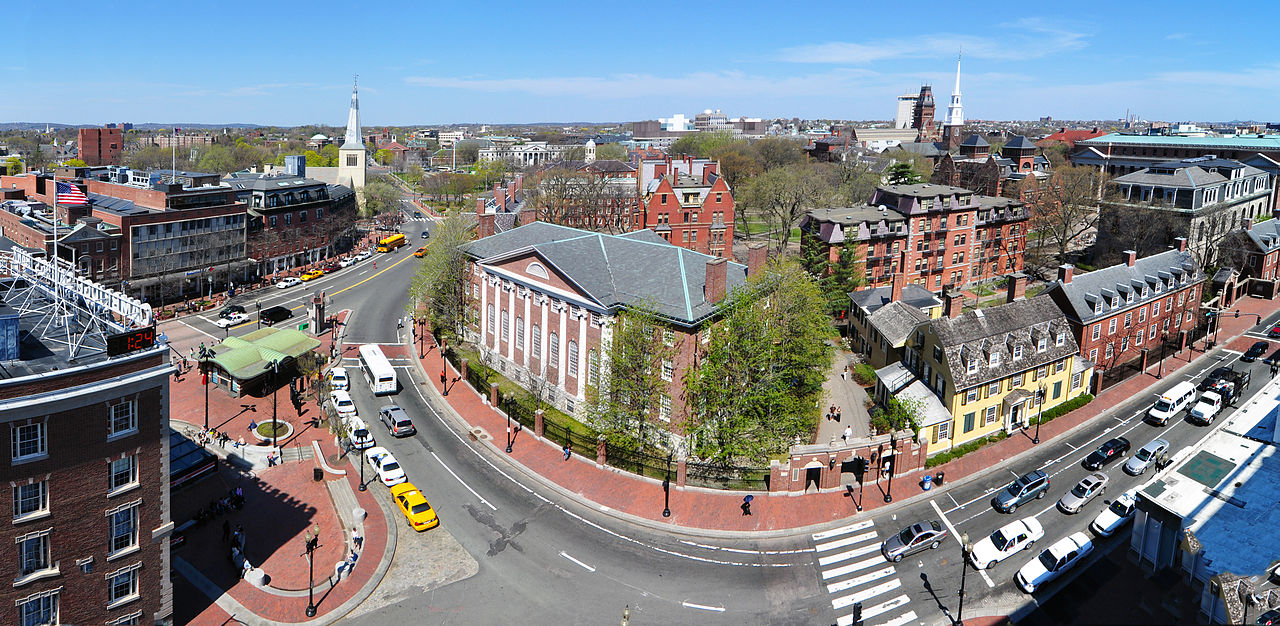
Harvard's 209-acre (85 ha) main campus is centered on Harvard Yard in Cambridge, about 3 miles (4.8 km) west-northwest of the State House in downtown Boston, and extends into the surrounding Harvard Square neighborhood. Harvard Yard itself contains the central administrative offices and main libraries of the university, academic buildings including Sever Hall and University Hall, Memorial Church, and the majority of the freshman dormitories. Sophomore, junior, and senior undergraduates live in twelve residential Houses, nine of which are south of Harvard Yard along or near the Charles River. The other three are located in a residential neighborhood half a mile northwest of the Yard at the Quadrangle (commonly referred to as the Quad), which formerly housed Radcliffe College students until Radcliffe merged its residential system with Harvard. The Harvard MBTA station provides public transportation via bus service and the Red Line subway.

Undergraduate admission to Harvard is characterized by the Carnegie Foundation as "more selective, lower transfer-in". Harvard College accepted 5.3% of applicants for the class of 2019, a record low and the second lowest acceptance rate among all national universities. Harvard College ended its early admissions program in 2007 as the program was believed to disadvantage low-income and under-represented minority applicants applying to selective universities, yet for the class of 2016 an Early Action program was reintroduced.

The undergraduate admissions office's preference for children of alumni policies have been the subject of scrutiny and debate as it primarily aids Caucasians and the wealthy and seems to conflict with the concept of meritocratic admissions.
Harvard's academic programs operate on a semester calendar beginning in early September and ending in mid-May. Undergraduates typically take four half-courses per term and must maintain a four-course rate average to be considered full-time. In many concentrations, students can elect to pursue a basic program or an honors-eligible program requiring a senior thesis and/or advanced course work. Students graduating in the top 4–5% of the class are awarded degrees summa cum laude, students in the next 15% of the class are awarded magna cum laude, and the next 30% of the class are awarded cum laude. Harvard has chapters of academic honor societies such as Phi Beta Kappa and various committees and departments also award several hundred named prizes annually. Harvard, along with other universities, has been accused of grade inflation, although there is evidence that the quality of the student body and its motivation have also increased. Harvard College reduced the number of students who receive Latin honors from 90% in 2004 to 60% in 2005. Moreover, the honors of "John Harvard Scholar" and "Harvard College Scholar" will now be given only to the top 5 percent and the next 5 percent of each class.

National University of Singapore

National University of Singapore

The National University of Singapore (Abbreviation: NUS) is a university located in Singapore. NUS is ranked consistently as one of Asia's top universities by both UK ranking systems, the QS World University Rankings and the Times Higher Education World University Rankings. According to the latest 2015 QS World University Rankings, NUS is ranked 12th in the world and retained its position as 1st in Asia. NUS also fared well in the 2014-15 Times Higher Education World University Rankings, coming in at No.25.


Founded in 1905, it is the oldest higher learning institute in Singapore, as well as the largest university in the country in terms of student enrollment and curriculum offered. The mission of NUS is to become a research-intensive university with an entrepreneurial dimension. NUS's main campus is located in southwest Singapore at Kent Ridge, with an area of approximately 1.83 km2 (0.71 sq mi). The Bukit Timah campus houses the Faculty of Law, Lee Kuan Yew School of Public Policy and research institutes, while the Duke-NUS Graduate Medical School Singapore is located at the Outram campus.

NUS has a semester-based modular system for conducting courses. It adopts features of the British system, such as small group teaching (tutorials) and the American system (course credits). Students may transfer between courses within their first two semesters, enrol in cross-faculty modules or take up electives from different faculties (compulsory for most degrees). Other cross-disciplinary initiatives study programmes include double-degree undergraduate degrees in Arts & Social Sciences and Engineering; Arts & Social Sciences and Law; Business and Engineering; and Business and Law.

NUS has 16 faculties and schools, including a Music Conservatory. Currently, it has seven overseas colleges at major entrepreneurial hubs in Shanghai and Beijing (China), Israel, India, Stockholm (Sweden), Silicon Valley and Bio Valley (US).
The NUS Overseas Colleges (NOC) programme started in 2001. Participants of the programme spend 6–12 months overseas, taking internships and courses at partner Universities. There are seven colleges: the Silicon Valley, California, United States; Philadelphia, Pennsylvania, US; Shanghai, China, Beijing, China, Stockholm, Sweden, India and Israel.

The local equivalent is the Innovative Local Enterprise Achiever Development (iLEAD) initiative, where students intern at innovative Singapore companies. This is a 7–8-month programme that cultivates an entrepreneurial mindset, and develops leadership and management skills.

NOC set up an entrepreneurial-themed residence, known as N-House. Located within the NUS Prince George's Park residence, this houses about 90 students, who are graduates of the NOC and iLEAD programmes. Entrepreneurial activities are also organised by the N-House residents, and these include entrepreneurial sharing sessions, business idea pitching and networking events.
Among the major research focuses at NUS are biomedical and life sciences, physical sciences, engineering, nanoscience and nanotechnology, materials science and engineering, infocommunication and infotechnology, humanities and social sciences, and defence-related research.

One of several niche research areas of strategic importance to Singapore being undertaken at NUS is bioengineering. Initiatives in this area include bioimaging, tissue engineering and tissue modulation. Another new field which holds much promise is nanoscience and nanotechnology. Apart from higher-performance but lower-maintenance materials for manufacturing, defence, transportation, space and environmental applications, this field also heralds the development of accelerated biotechnical applications in medicine, health care and agriculture.